The Summer Road Trip Checklist Every Atlanta Driver Needs (Before You Hit I-75)
# The Summer Road Trip Checklist Every Atlanta Driver Needs (Before You Hit I-75)
Summer in Georgia means one thing: road trips. Whether you're heading to the Gulf Coast beaches, the Smoky Mountains, or just making the drive down to Savannah, your car is about to work harder than it has all year. The combination of Atlanta's brutal heat and hundreds of highway miles is the perfect recipe for a breakdown — unless you prepare.
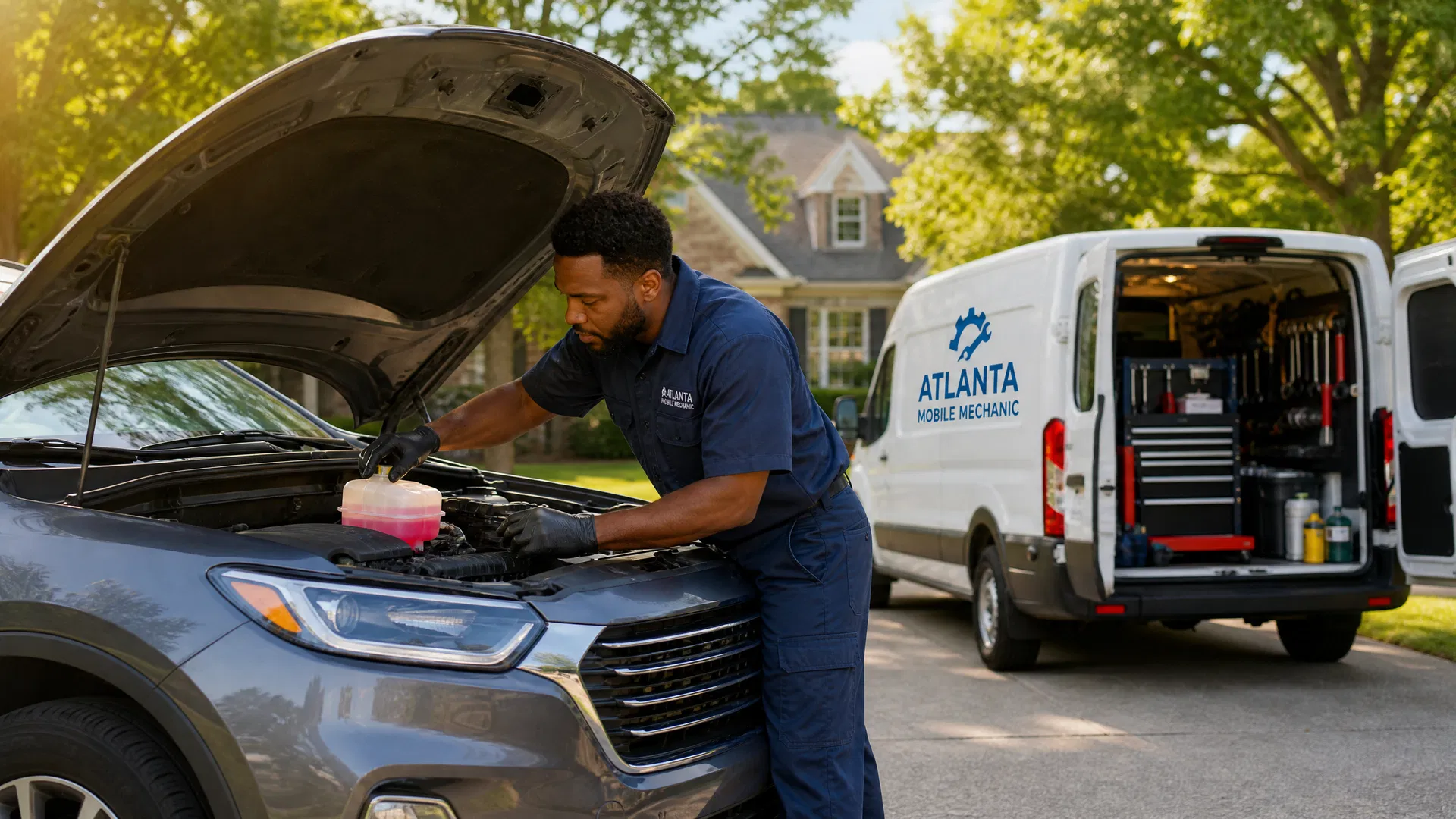
The good news? You don't need to drop your car off at a shop for two days to get road-trip ready. A mobile mechanic can run through every critical system right in your driveway, usually in under an hour. Here's exactly what should be checked before you load up the cooler and hit the interstate.
Your Cooling System Is the First Thing That Fails in Georgia Heat
Atlanta summers regularly push past 95 degrees, and asphalt temperatures can exceed 140°F. Your engine is generating its own heat on top of that. If your cooling system has even a minor weakness — a slow coolant leak, a thermostat that's starting to stick, or a radiator fan that's intermittent — it will choose the worst possible moment to fail.
A pre-trip inspection should include checking coolant levels and condition (old coolant turns acidic and eats gaskets), inspecting hoses for soft spots or swelling, testing the thermostat operation, and verifying the radiator fan kicks on at the right temperature. Overheating on I-75 south of Macon, where the next exit might be 15 miles away, is not just inconvenient — it can warp your cylinder head and turn a $30 thermostat into a $2,000 engine repair.
Tires: The One Thing Between You and the Road at 75 MPH
Most drivers glance at their tires and think "they look fine." But looks can be deceiving. Tread depth, sidewall condition, and proper inflation are all critical at highway speeds, and Georgia's heat makes everything worse. Under-inflated tires generate excess heat, which accelerates wear and increases blowout risk.
A proper tire inspection checks tread depth (legal minimum is 2/32", but 4/32" is the safe threshold for wet roads), tire pressure (every 10°F increase adds ~1 PSI, so summer heat over-inflates tires), sidewall condition for bulges or cracks, uneven wear patterns that signal alignment issues, and your spare tire — because 40% of spare tires are flat when drivers actually need them.
A mobile mechanic checks all five in minutes. If you need new tires, we can recommend the right ones for your vehicle and driving style before you buy.
Brakes Don't Give You a Second Chance at 70 MPH
Mountain driving — whether it's the north Georgia hills or the Appalachian passes — puts enormous stress on brakes. Descending long grades heats brake pads and rotors far beyond normal city driving temperatures. If your pads are already worn thin, you might experience brake fade: that terrifying moment when you press the pedal and the car doesn't slow down as expected.
A brake inspection before a mountain trip should measure pad thickness (minimum 3mm for safe highway driving), check rotor condition for scoring or warping, verify brake fluid level and condition, and inspect brake lines for leaks or corrosion. Replacing brake pads in your driveway takes about 45 minutes per axle. Replacing them on the side of a mountain road after they've failed? That's a tow truck, a hotel room, and a much bigger bill.
The Battery That Starts Fine Today Might Not Tomorrow
Here's a fact that surprises most drivers: heat kills car batteries faster than cold does. Atlanta's summer temperatures accelerate the chemical degradation inside your battery. A battery that's been weakening all spring might start your car fine in your garage but fail after sitting in a hot parking lot at your destination for eight hours.
A proper battery test measures cranking amps under load — not just voltage at rest. If your battery is more than three years old and you're planning a trip, this test takes two minutes and can save you from being stranded in a beach town parking lot searching for an auto parts store.
Belts and Hoses: The Rubber Parts That Hate Heat
The serpentine belt drives your alternator, power steering, A/C compressor, and water pump. If it snaps on the highway, you lose all of those systems simultaneously. Your engine will overheat within minutes, your power steering will lock up, and your battery will start draining.
Rubber deteriorates faster in extreme heat. A belt that looks fine on top might be cracked on the underside where you can't see it. Hoses develop internal weakness before they show external signs. A mobile mechanic can spot the early signs — glazing on belts, soft spots on hoses, seepage at connections — and replace them before they leave you stranded.
The 10-Minute Fluid Check That Prevents $1,000 Problems
Beyond coolant, your vehicle relies on several fluids that degrade over time and distance:
Transmission fluid should be checked especially if you're planning mountain driving, which puts extra stress on the transmission. Dark, burnt-smelling fluid means it's overdue for service.
Brake fluid absorbs moisture over time, which lowers its boiling point. On long mountain descents, degraded brake fluid can actually boil, creating air bubbles that make your brake pedal feel spongy.
Power steering fluid that's low or contaminated makes the pump work harder, which can lead to failure on a long drive.
Windshield washer fluid seems trivial until you're driving into a sunset on I-16 with a bug-splattered windshield and an empty reservoir.
Why a Mobile Mechanic Makes More Sense for Pre-Trip Inspections
Traditional shops charge a diagnostic fee ($100-$200) just to look at your car, and you'll need to arrange transportation while it's there. A mobile mechanic performs the same inspection — often more thoroughly, because we're not rushing to clear a lift for the next customer — right where your car is parked.
The math is simple. A shop inspection plus the time cost of dropping off and picking up your car, possibly over two days, versus a mobile mechanic who arrives at your home, runs through everything in 45 minutes to an hour, and gives you a clear report of what's good and what needs attention. If repairs are needed, many can be done on the spot.
At Fixed in Minutes, our pre-trip inspections cover every system mentioned above plus lights, wipers, air filter, and A/C performance. We serve the entire metro Atlanta area — from Alpharetta to College Park, Decatur to Marietta — and we come to you.
The Bottom Line
A breakdown 200 miles from home turns a vacation into a logistics nightmare. Towing alone costs $80-$150 base plus $4-$7 per mile in Georgia. Add a hotel room, meals while you wait for repairs, and the repair itself at an unfamiliar shop that knows you're stuck — and a preventable breakdown can easily cost $500-$1,000 more than it should have.
A 45-minute pre-trip inspection catches problems while they're still cheap to fix and while you're still in your own driveway. That's not just good maintenance — it's good math.
Ready to get road-trip ready? Call or text Fixed in Minutes to schedule your pre-trip inspection. We'll come to you, check everything, and make sure your car is as ready for summer as you are.